

Every Pera Tile product carries a set of technical classifications: slip resistance, wear, appearance, strength and chemical performance. They are what turn a beautiful material into a sound specification. Here is how to read them, using our DreamScapes porcelain pavers as the example.
A real example: DreamScapes technical data
The technical data for DreamScapes, 2 cm color-body porcelain made in the USA, reads:
| Rating | DreamScapes |
|---|---|
| Water absorption | ≤ 0.5% |
| DCOF | > 0.42 |
| R rating and ANSI category | R11, EW (exterior wet) |
| PEI | 3 |
| Frost resistance | Resistant |
| Scratch resistance | 7 Mohs |
| Breaking strength | 2800 lbf |
| Chemical and stain resistance | Resistant |
| Shade variation | V2 (Nextone and limestone looks), V3 (travertine looks), V4 (quartz looks) |
| Minimum grout joint | 3/16″ on a concrete base, 1/4″ on sand or pedestals |

DreamScapes 2 cm porcelain pavers
Here is what each line means.
Slip resistance: DCOF
DCOF (Dynamic Coefficient of Friction) measures the force needed to keep a person who is already walking from slipping, tested under ANSI A326.3. The standard sorts hard flooring into five use categories:
- Interior, Dry (ID): 0.42 or more, tested dry. Lobbies, offices, showrooms, dry residential rooms.
- Interior, Wet (IW): 0.42 or more, tested wet. Foyers, restrooms, kitchens, baths, retail floors.
- Interior, Wet Plus (IW+): declared by the manufacturer. Barefoot and wet areas such as pool surrounds, locker rooms and showers.
- Exterior, Wet (EW): declared by the manufacturer. Patios, pool decks, walkways.
- Oils and greases (O/G): declared by the manufacturer. Commercial kitchens and food prep.
A tile below 0.42 wet, which includes most polished surfaces, should only go where the floor stays dry when walked on. For wet floors, specify honed, brushed, tumbled or textured finishes. Small polished mosaics, with their many grout joints, can work as accents; check with the project’s specifier.
Slip resistance: R rating
The European R rating (DIN 51130) is a ramp test: a person in work boots walks an oiled ramp, and the angle at which they slip sets the class. Use it alongside DCOF for European tile.
- R9 (6° to 10°): dry interior areas.
- R10 (10° to 19°): areas kept mostly dry, such as bathrooms, kitchens and hallways.
- R11 (19° to 27°): wet interior and exterior areas, patios, light commercial kitchens. DreamScapes is R11.
- R12 (27° to 35°): high-contamination zones such as commercial kitchens and ramps.
- R13 (over 35°): heavy industry.
Wear: PEI
The PEI class (ASTM C1027) measures how well a glazed surface resists visible wear from foot traffic, from 0 to 5. It rates the surface only, not the overall quality of the tile.
- PEI 0: walls only.
- PEI 1: very light residential, such as bathroom walls.
- PEI 2: light residential, soft footwear.
- PEI 3: all residential and light commercial, such as kitchens, offices and boutiques.
- PEI 4: heavy residential and medium commercial, such as restaurants, hotel lobbies and entryways.
- PEI 5: heavy commercial, such as airports, shopping centers and schools.
Appearance: V rating and number of faces
The V rating (ANSI A137.1) tells you how much color, tone and texture vary from tile to tile:
- V0, very uniform: for seamless, monolithic fields.
- V1, uniform: minimal differences; clean and predictable.
- V2, slight: clear differences in texture or pattern with similar colors.
- V3, moderate: colors and texture vary noticeably; view a range before choosing.
- V4, substantial: bold, intentional variation, as in stone, wood and rustic looks.
The number of faces is how many different designs are printed (or, for 3D tiles, molded) for one size and color. The more faces, the less often a pattern repeats on the floor.
Hardness and strength
- Mohs scratch hardness (ASTM C1895) ranks scratch resistance on the 1 to 10 mineral scale: 3 is wall tile only, 5 suits most glossy porcelain on residential floors, 6 most matte porcelain in heavy residential and light commercial use, and 7 and above commercial and exterior use. Matte finishes usually score higher than polished, and through-body porcelain resists deep scratches better than glazed tile.
- Breaking strength is the force that breaks a tile. Under ANSI A137.1 and ASTM C648, floor tile must average at least 250 lbf and glazed wall tile 125 lbf. European tile is tested to EN ISO 10545-4 in newtons: dry-pressed porcelain 7.5 mm and thicker must reach 1300 N. The two methods load the tile differently, so the numbers do not convert. Where a sheet says “meets EN 14411”, that is the minimum the tile clears, not the load at which it broke; if loading governs the project, ask for the tested value.
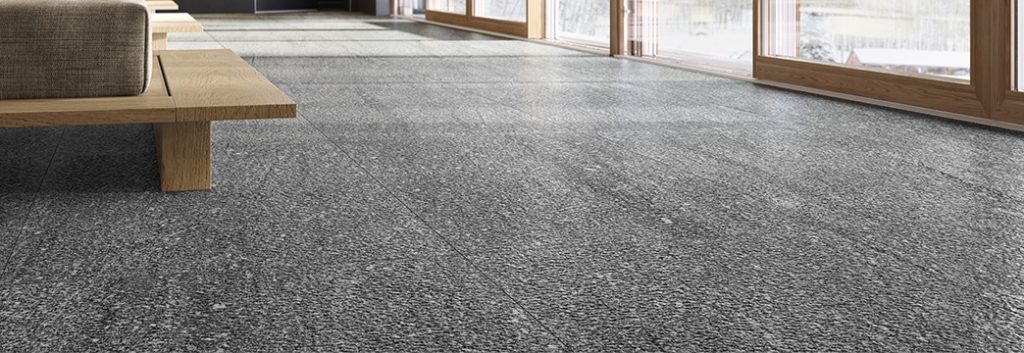
Upstone in London Grigio
Chemical and stain resistance
- Chemical resistance (ASTM C650 or EN ISO 10545-13) tests household chemicals, pool salts, and acids and alkalis. ASTM reports affected or not affected; the European standard grades A (highest) to C. The European standard requires at least class B against household chemicals and pool salts.
- Stain resistance (ASTM C1378 or EN ISO 10545-14) applies four cleaning steps until a stain comes off. Class 5 means running hot water removed it; class 1 means nothing did. Glazed tile requires at least class 3.
Each collection’s technical data in our catalogue names the standard its values were tested to.
Installation: the three rules of lippage control
Lippage, a height difference between neighboring tiles, is the most common problem on large-format projects. ANSI A108.02 controls it with three rules that work only together:
- Maximum 33% offset: tiles with any side over 15″ laid in a running bond or other offset pattern go at a third, not half. A half offset puts the high edge of one tile against the low edge of the next.
- Minimum grout joint: for tiles with any side over 15″, 1/8″ for rectified tile and 3/16″ for calibrated tile, wider where the tile has more warpage, and never under 1/16″.
- Substrate flatness: for tiles with an edge of 15″ or more, no more than 1/8″ in 10 feet and 1/16″ in any 24″.
Lighting matters too. Wall-wash fixtures and sidelight from windows cast shadows that exaggerate lippage. The TCNA Handbook places wall-wash lights at least 24″ from the tile face; a mock-up under the real lighting is the only reliable preview.
Where to find the data
- Catalogue: each collection’s technical data, and the full Technical References section, are in the 2026 Pera Tile catalogue.
- Product pages: the Additional Information tab lists material, finish, size, thickness, shade variation, stock and lead time, and slip rating and water absorption where tested; the Line Sheet download has the collection’s technical data.
- Trade accounts get the full technical library: spec sheets, installation guides and care instructions. Apply for a trade account, or find a dealer with the Dealer Locator.

